
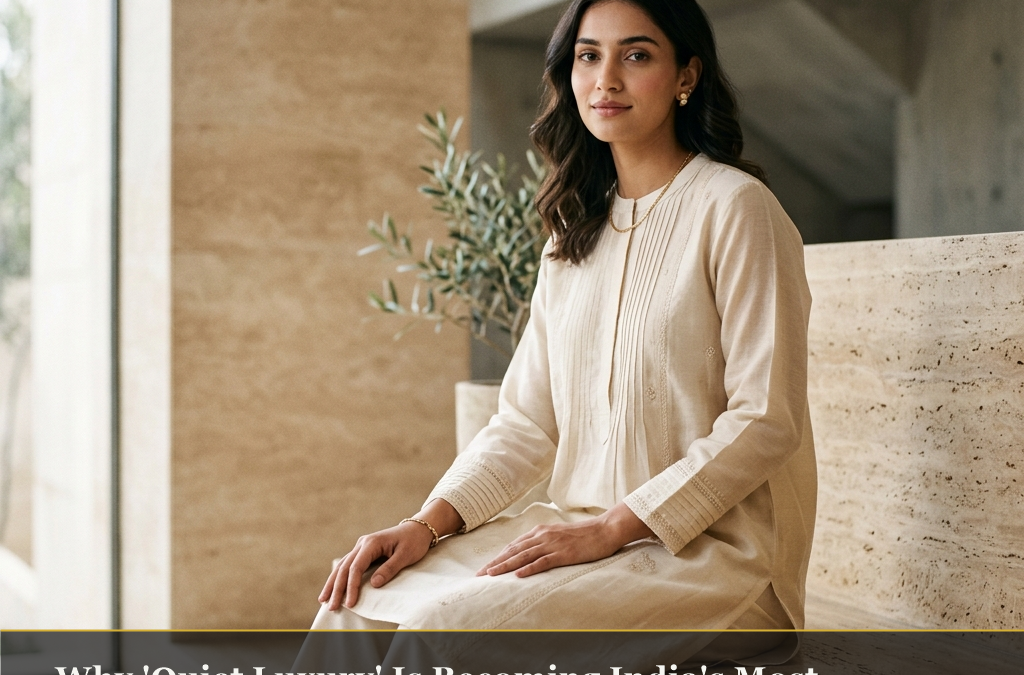
by Anahita Shelat, Founder & Creative Head | July 22, 2026 | 0 Comments
Contents
- 1 1. Redefining the Status Symbol: The Rise of Quiet Luxury Indian Fashion
- 2 2. Understated vs. Western Minimalism: The Indian Context
- 3 3. Occasion Wear Reimagined: The Rise of the Versatile Heirloom
- 4 4. The Power of Muted Palettes and Fine Tailoring
- 5 5. How Homegrown Labels Drive Quiet Luxury Indian Fashion
- 6 6. A Final Thought
- 7 Frequently Asked Questions
- 7.1 What is the difference between Western minimalism and quiet luxury Indian fashion?
- 7.2 Why are Indian buyers shifting away from heavy bridal and occasion wear?
- 7.3 Does quiet luxury Indian fashion mean avoiding color in Indian ethnic wear?
- 7.4 How can I identify high-quality quiet luxury Indian clothing?
- 7.5 How does quiet luxury Indian fashion support sustainable fashion in India?
- 8 Leave a Reply
The landscape of quiet luxury Indian fashion is undergoing a quiet yet profound revolution, reshaping how we perceive status, elegance, and personal expression. For generations, luxury in the subcontinent was defined by maximalism—heavy zari work, intricate embroideries, and loud, logo-heavy statement pieces that announced their presence from across the room. Today, however, a new generation of style-conscious Indian buyers aged 25 to 45 is seeking something entirely different. They are moving away from loud, occasion-only garments and embracing understated, monochrome, and craftsmanship-first designs that speak in a whisper rather than a shout.
This transition represents more than a passing aesthetic trend; it is the next chapter in the evolution of modern Indian couture. While our previous discussions highlighted why underrated luxury homegrown brands in India are capturing the spotlight, this post delves into the core philosophy driving this shift: how the principles of quiet luxury Indian fashion are transforming minimalism into the ultimate modern status symbol. In an era where anything can be mass-produced, true luxury lies in restraint, silence, and the invisible details that only the wearer can truly appreciate.
1. Redefining the Status Symbol: The Rise of Quiet Luxury Indian Fashion
For decades, luxury fashion in India was synonymous with excess. The weight of a lehenga or the shine of a saree’s border was directly proportional to its perceived value. However, the modern luxury consumer is rewriting this narrative. The appeal of ostentatious, single-wear garments is rapidly fading, replaced by a deep appreciation for the principles of quiet luxury Indian fashion. Today’s buyers are discovering that true elegance does not need to demand attention; it commands it through impeccable construction and subtle refinement.
This shift is largely driven by a desire for individuality and a rejection of repetitive, commercial designs. When mainstream luxury becomes defined by predictable patterns and mass marketing, distinction is found in the unadorned.
By stripping away the superficial layers of heavy embellishment, designers are focusing on the purity of the silhouette and the quality of the raw material. When we look closely at this shift, it becomes apparent that quiet luxury Indian fashion is defined by the depth of the karigari rather than the scale of the brand, putting the artisan at the center of the garment’s narrative.
To truly understand this aesthetic shift, we must examine the core pillars that define it:
- Fabric Integrity: Prioritizing hand-spun and hand-woven textiles like Chanderi silk, Khadi, and organic cotton.
- Structural Precision: Emphasizing fine tailoring, immaculate seams, and anatomical drapes over surface patterns.
- Muted Harmony: Utilizing natural, earthen color palettes that calm the eyes and highlight fabric texture.
- Artisanal Legacy: Celebrating the direct handiwork of traditional weavers and karigars.
- Modern Versatility: Crafting garments that transition effortlessly across daily and occasion wear.
As consumers seek greater alignment between their wardrobes and their values, the focus has shifted toward meaning-driven luxury Indian wear brands. Buyers want to know the origin of their clothes, the hands that crafted them, and the artistic intent behind each design choice.
In this context, understated fashion becomes a form of self-expression that values personal satisfaction over public display. As a result, the conversation around quiet luxury Indian fashion has shifted from external display to internal satisfaction—a garment that feels exquisite against the skin and carries a quiet story known only to the person wearing it.
2. Understated vs. Western Minimalism: The Indian Context
When discussing quiet luxury, it is easy to assume it is merely a copy of Western minimalism. The global rise of neutral tones, clean trench coats, and logo-free luxury has certainly influenced wardrobes worldwide. However, quiet luxury Indian fashion is not about adopting a sterile, color-deprived aesthetic. In India, understated luxury must co-exist with a rich cultural heritage and a climate that demands breathability and movement. It is a distinct form of minimalism—one that is warm, textured, and deeply rooted in local craft traditions.
Western minimalism often relies on flat, industrial fabrics like heavy wools, stiff cottons, and synthetic blends. In contrast, Indian understatement is built on the sensory richness of hand-woven textiles. A quiet luxury garment in India might be a monochrome ivory kurta, but it is crafted from hand-spun Chanderi silk or Jamdani cotton.
The beauty lies not in the absence of detail, but in the subtle textures of the weave itself—the slight irregularities of the handloom thread, the soft luster of natural silks, and the way the fabric drapes organically around the body. In this sense, quiet luxury Indian fashion is defined by the depth of the textile rather than the noise of the design.
3. Occasion Wear Reimagined: The Rise of the Versatile Heirloom
Furthermore, while Western minimalism focuses on simplicity for the sake of functionality, Indian quiet luxury is an exercise in editing. It is about taking our deep craft heritage and removing the noise. We are not discarding our textile legacy; we are allowing it to breathe. Instead of covering a beautiful handloom fabric with heavy embroidery, we let the weave be the focus.
This balance between heritage and simplicity is what makes quiet luxury Indian fashion so unique, offering a modern alternative that feels authentic to our roots while remaining clean and contemporary. According to recent Business of Fashion’s retail analysis, this thoughtful editing is precisely what distinguishes high-end homegrown labels from mass-produced luxury brands that rely on surface decoration to hide inferior materials.
One of the most practical reasons driving the shift toward quiet luxury Indian fashion is the changing lifestyle of the modern consumer. Historically, heavy Indian occasion wear was designed for specific, formal events—weddings, festivals, and family celebrations. Once the event passed, these heavily embellished garments were stored away in trunks, rarely seeing the light of day. Today’s buyers are questioning this approach, choosing instead to build wardrobes around fewer, higher-quality pieces that offer versatility and longevity.
The modern wardrobe demands fluidity. A luxury silk jacket or a finely draped saree should be capable of transitioning from an intimate family gathering to a contemporary art gallery opening or a formal dinner. By focusing on clean lines, subtle detailing, and muted colors, quiet luxury garments break free from the constraints of occasion-only dressing.
By investing in versatile garments, buyers are proving that quiet luxury Indian fashion is inherently linked to practicality, modern utility, and conscious ownership. Consequently, the versatility of quiet luxury Indian fashion makes it the perfect choice for the modern conscious wardrobe, expanding the wearability of traditional fabrics far beyond the wedding season.
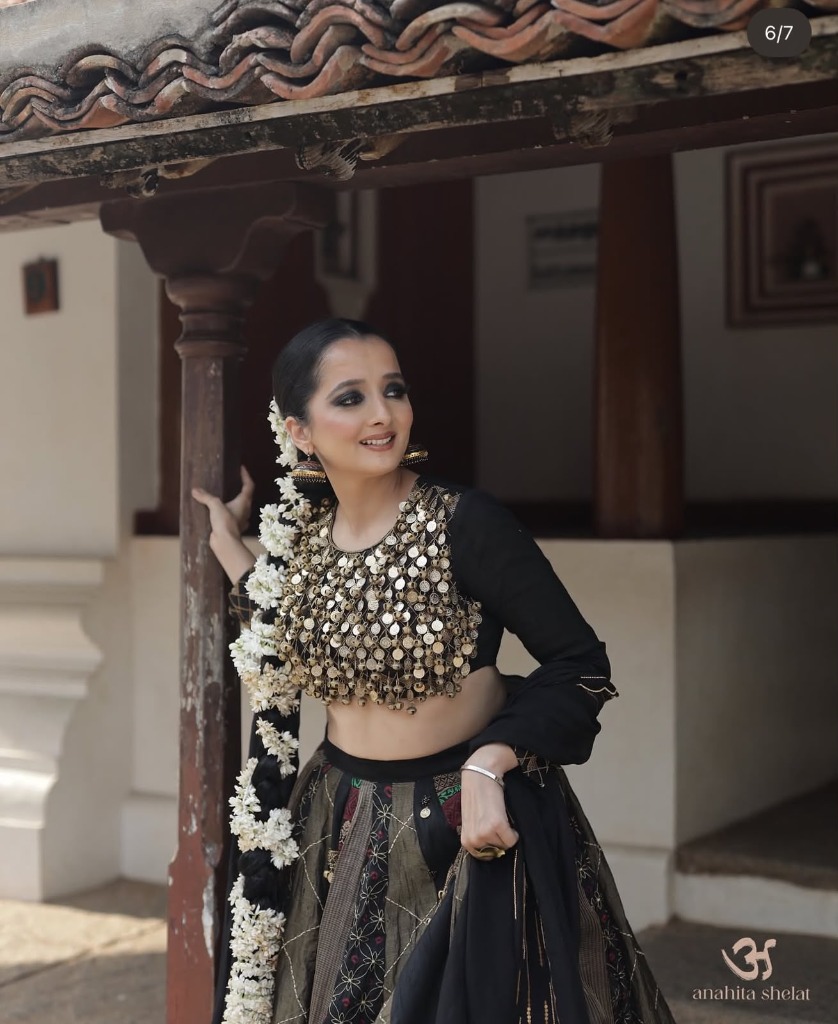
This movement reflects a growing consumer consciousness regarding fashion consumption. There is a visible exhaustion with the cycle of buying cheap, trend-led clothing that degrades after a few washes. Instead, consumers are recognizing that investing in a single, masterfully constructed garment is far more rewarding than purchasing multiple mass-produced outfits. This philosophy aligns perfectly with the reasons why handcrafted Indian clothing is reclaiming its position at the apex of the luxury fashion pyramid.
4. The Power of Muted Palettes and Fine Tailoring
In the vocabulary of quiet luxury Indian fashion, color and construction are the primary mediums of storytelling. For years, the Indian festive palette was dominated by saturated jewel tones—crimson, emerald, royal blue, and marigold. While these colors hold a permanent place in our cultural celebrations, there is a growing movement toward a more subdued, natural palette. Ivory, sage green, dusty rose, slate gray, stone, and warm champagne are emerging as the new colors of luxury.
These muted tones offer a visual softness that is rare in conventional ethnic wear. They allow the texture of the fabric and the precision of the tailoring to take center stage. When a garment is rendered in a single, understated color, there is nowhere for bad construction to hide.
Every seam, every darts, and every drape must be executed with mathematical precision. Fine tailoring replaces heavy embellishment as the true marker of quality, turning the focus of fashion back to the shape and movement of the human form.
Thus, the aesthetics of quiet luxury Indian fashion are built on structural honesty, fine engineering, and tailor-made comfort. With its focus on shape and drape, quiet luxury Indian fashion celebrates craftsmanship without the need for visual noise, proving that beauty does not have to be loud to be impactful.
This quiet visual philosophy is primarily represented by a refined spectrum of natural tones:
- Ivory & Alabaster: The foundational shades of purity and understated warmth.
- Sage & Olive: Earthen greens that evoke a organic connection to nature.
- Dusty Rose & Mauve: Soft, weathered shades that offer subtle romanticism.
- Warm Champagne & Stone: Rich neutrals that shimmer gently without flashiness.
This focus on form and fit requires an elevated level of design maturity. Rather than relying on standard, block-printed patterns or heavy borders, designers must manipulate fabric to create depth and structure. Subtle design interventions—such as pin-tucks, structured collars, hidden pockets, and delicate hand-finished hems—become the markers of luxury. This level of detailing is highly appreciated by the modern heritage woman who understands that the true value of a garment is found in the elegance of its execution and the comfort of its drape.
5. How Homegrown Labels Drive Quiet Luxury Indian Fashion
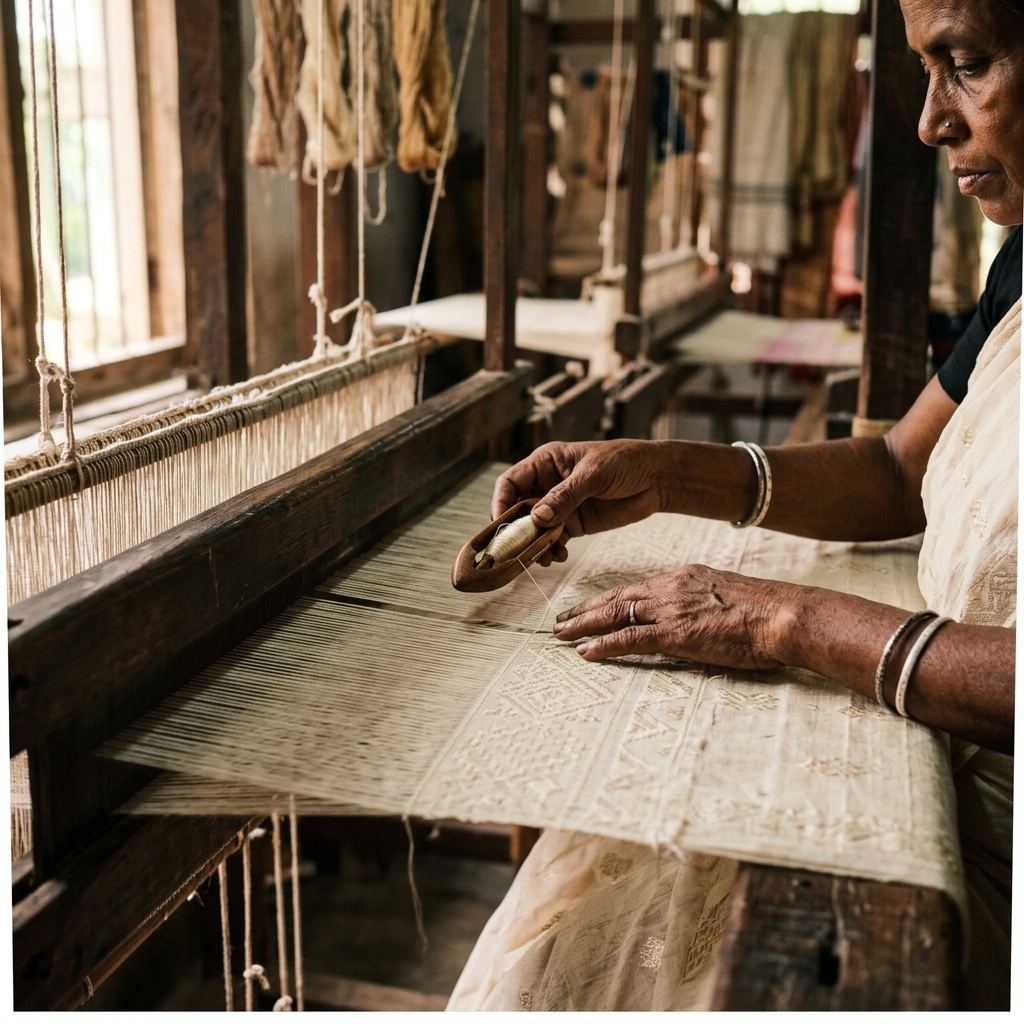
The rise of understatement in Indian fashion has created a unique opportunity for independent homegrown labels. Mass-market luxury brands are built on scalability and high-volume production, which often forces them to rely on synthetic fibers, machine embroidery, and standardized designs. Homegrown labels, on the other hand, operate on a scale that allows them to prioritize slow craftsmanship, custom development, and close collaboration with local weavers and artisans. This focus on slow production is central to the appeal of quiet luxury Indian fashion.
Because these garments are created in limited quantities, they possess an inherent exclusivity that cannot be replicated by global luxury houses. Each piece is unique, carrying the subtle signature of the artisan who wove the fabric or finished the seams.
This dedication to craft ensures that the garments are built to last, offering a level of durability and timelessness that aligns with the principles of sustainable fashion. The rise of independent designers in this space is a testament to how quiet luxury Indian fashion is reviving artisanal agency, heritage pride, and clean aesthetics.
This relationship between the designer and the weaver is the foundation upon which quiet luxury Indian fashion is built, fostering a circular fashion ecosystem that values human hands over automated assembly lines.
By choosing to support local designers, consumers are also contributing to the preservation of our textile heritage. However, this is not heritage for the sake of nostalgia. It is about taking traditional weaving techniques and applying them to contemporary, minimalist designs that fit seamlessly into a modern lifestyle. As highlighted in Vogue India’s reports on conscious fashion, the modern consumer is looking for garments that celebrate heritage without being weighed down by it, finding beauty in clean silhouettes that carry the soul of traditional Indian craftsmanship.
6. A Final Thought
The growing preference for quiet luxury Indian fashion represents a maturing of the Indian fashion consumer. We are moving away from a period of ostentation and logo-driven status, and entering an era of self-assured elegance, material literacy, and conscious consumption. True luxury is no longer defined by how much space a garment occupies or how brightly it shines under artificial lights. Instead, it is found in the quiet elegance of a muted palette, the precision of a hand-finished hem, and the heritage of a hand-woven thread.
As we continue to redefine our relationship with clothing, the brands that succeed will be those that honor the intelligence of the wearer. Ultimately, the movement towards quiet luxury Indian fashion is a celebration of personal style that honors both the artisan and the wearer. By offering pieces that prioritize craftsmanship, versatility, and quiet distinction, homegrown labels are proving that understated fashion is not about hiding—it is about presenting one’s authentic self with clarity, grace, and quiet confidence.
Frequently Asked Questions
What is the difference between Western minimalism and quiet luxury Indian fashion?
Western minimalism often relies on flat, stiff fabrics and functional, sterile designs. Quiet luxury in Indian fashion combines clean, modern silhouettes with the sensory richness of traditional hand-woven textiles like Chanderi silk, khadi, and Jamdani, focusing on subtle texture rather than heavy surface embellishment.
Why are Indian buyers shifting away from heavy bridal and occasion wear?
Modern buyers are looking for versatility, longevity, and sustainable value. Heavily embellished occasion wear is often worn once and stored away, whereas understated luxury pieces can be styled in multiple ways and worn across different settings, making them much more practical and meaningful investments.
Does quiet luxury Indian fashion mean avoiding color in Indian ethnic wear?
No. While quiet luxury embraces muted palettes like ivory, sage, champagne, and dusty rose, it also celebrates rich, natural monochrome tones. The focus is on color harmony and simplicity, ensuring that the silhouette and fabric texture remain the main focus rather than contrasting patterns or loud prints.
How can I identify high-quality quiet luxury Indian clothing?
Look for the purity of the fiber (natural silks, cottons, wools), the quality of the tailoring (neat seams, balanced drape, precise cuts), and the presence of hand-finished details. True luxury is felt in the weight and breathability of the fabric and the comfort of the garment when in motion.
How does quiet luxury Indian fashion support sustainable fashion in India?
Quiet luxury is inherently tied to the slow fashion movement. By focusing on timeless designs and high-quality materials, it encourages consumers to buy fewer, better pieces. This shift supports local artisan weavers, reduces waste, and keeps traditional craft techniques alive through contemporary design.
This Article is written by Anahita Shelat, founder and creative head of Anahita Shelat one of the best Hand embroidered Indian Clothing brand.
Leave a Reply